Quick Answer
Air conditioners cool indoor spaces by removing heat and moisture from indoor air and transferring that heat outdoors using a closed refrigerant cycle. AC moves heat rather than making cold.
Air conditioning works through continuous heat transfer rather than cold generation. The refrigeration cycle circulates refrigerant through the compressor, condenser, expansion device, and evaporator components, moving heat from indoors to outdoors while removing moisture. Let us explain each step of the cooling process and why understanding how AC works helps you choose and maintain systems properly.
Key Takeaways
- AC doesn’t create cold air, it basically moves heat from inside your home to outside.
- Every AC system uses the same four-step refrigeration cycle: evaporate, compress, condense, and expand.
- Proper sizing, regular maintenance, and smart controls are the biggest factors in efficiency and running costs.
How Cooling Really Works
The top misconception about air conditioning is that it makes cold air. Air conditioners actually remove heat from indoor air and reject it outside, which makes the remaining indoor air feel cooler. Heat must be moved somewhere else because thermodynamics prevents simply destroying it.
A refrigerator works the same way, moving heat from inside the box to the kitchen. A sponge wringing water out provides another useful analogy, where the AC wrings heat energy out of indoor air and squeezes it outdoors.
Heat pumps reverse this process for heating.
Humidity removal happens simultaneously because cold evaporator coils cause water vapour to condense out of warm indoor air, and drier air feels cooler even at the same temperature.
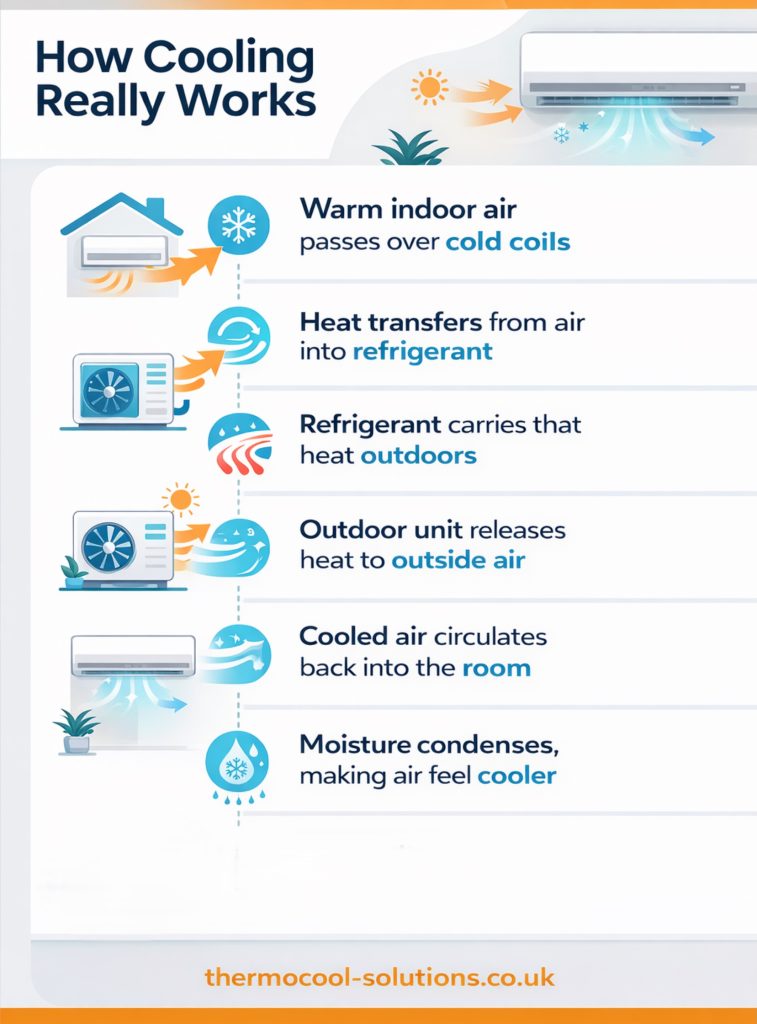
The Five-Step Air Conditioning Cycle
Air conditioners cool your home using a continuous refrigeration cycle that transfers heat from indoors to outdoors. Breaking this into five simple steps makes the process easy to follow. The cycle starts inside your home, where warm air first meets the cold evaporator coil.
Step 1: Heat Absorption
Inside your home, warm air passes over a very cold coil (the evaporator).
The cold refrigerant inside that coil absorbs heat from the air. As heat is removed, the air becomes cooler and is blown back into your rooms.
The refrigerant warms up during this step, but it stays cool enough to keep pulling heat out of the air.
Step 2: Evaporation
As the refrigerant absorbs heat, it changes from a liquid into a gas. This change of state allows it to remove a large amount of heat quickly and efficiently.
The low pressure inside the system keeps the refrigerant cold enough to cool your home properly.
Step 3: Compression
The compressor pulls in the warm refrigerant gas and squeezes it tightly.
When a gas is compressed, its temperature rises. This makes the refrigerant much hotter than the outdoor air, which is important for the next step.
Step 4: Heat Release
The hot refrigerant moves to the outdoor unit. A fan blows outdoor air across the coil, allowing the heat to leave the refrigerant. As it loses heat, the refrigerant turns back into a liquid.
This is the point where the heat from inside your home is actually released outside.
Step 5: Expansion and Cycle Reset
Before returning indoors, the refrigerant passes through an expansion device that quickly lowers its pressure. When pressure drops, the refrigerant becomes cold again.
It then returns to the indoor coil, ready to absorb more heat, and the cycle repeats.
Key Components of an AC System
An air conditioning system works because different parts handle airflow, heat transfer, and temperature control. These components are split between the indoor and outdoor units, and each one has a specific role in keeping your home comfortable.
Indoor Components
- The evaporator coil is where heat is removed from indoor air. As air passes over this cold coil, heat is absorbed, and cooler air is sent back into your rooms.
- The air filter protects the system by trapping dust and debris before they reach the coil or blower. Clean filters improve airflow and help maintain good indoor air quality.
- The blower fan moves air across the evaporator coil and pushes cooled air through ductwork or directly into living spaces.
- The thermostat tells the system when to turn on and off based on your chosen temperature.
Home maintenance typically involves replacing air filters regularly and ensuring the condensate drain remains clear to prevent water buildup.
Outdoor Components
The outdoor unit contains the compressor, condenser coil, and fan.
- The compressor pressurises the refrigerant so it can release heat efficiently.
- The condenser coil allows heat to transfer from the refrigerant into the outside air.
- The fan helps move air across the coil to carry that heat away.
Because refrigerant is regulated under UK law, leak detection, repair, and system recharging must be handled by qualified, licensed technicians.
If your system needs professional support, we provide full air conditioning services, including maintenance, diagnostics, and repairs to keep everything running safely and efficiently.
Why and How Air Conditioning Removes Humidity
Moisture removal happens when warm humid indoor air contacts the cold evaporator coil. Water vapour condenses into liquid droplets on the coil surface, just like condensation forming on a cold drink glass. The condensate drips into a drain pan and flows away through the condensate line.
Removing moisture makes air feel cooler even at the same temperature because dry air allows sweat to evaporate from skin more easily, which creates a cooling sensation.
Common humidity problems include:
- Clogged drains that back up water
- Dirty coils that reduce condensation surface area
- Oversized AC units that cool rooms quickly without running long enough to remove much moisture
Proper system sizing improves humidity control substantially.
Types of Air Conditioning Systems
Air conditioning systems come in several types suited to different homes and needs.
- Split systems use separate indoor and outdoor units connected by refrigerant lines, with wall-mounted indoor units common in UK homes.
- Ducted central systems distribute cooled air through ductwork to multiple rooms from a single indoor unit.
- Ductless mini-splits allow multiple indoor units on one outdoor unit for zoned cooling.
- Packaged systems combine all components in one outdoor cabinet, typical for commercial roofs.
- Portable and window units are self-contained but less efficient than split systems.
Split systems suit single-room cooling in homes without ductwork. Ducted systems work for whole-home cooling when ductwork exists or can be added. Budget, home size, and zoning needs determine which type makes sense.
The table below shows common UK air conditioning system types and where each one works best.
| System Type | Best Use Case | Key Advantage | Main Limitation |
|---|---|---|---|
| Wall-mounted split | Single room cooling | Efficient, quiet, no ductwork needed | One indoor unit per room increases cost |
| Multi-split VRF | Multiple rooms with independent control | Zoned cooling, one outdoor unit | Higher upfront cost than single splits |
| Ducted central system | Whole home cooling | Even distribution, hidden indoor units | Requires ductwork installation or existing ducts |
| Portable unit | Temporary cooling, renters | No installation, movable | Inefficient, noisy, obstructs windows |
Each system type delivers cooling through the same refrigeration cycle, but installation complexity, efficiency, and running costs vary substantially.
Choosing the right type for your space prevents overspending on unnecessary capacity or struggling with undersized equipment.
How Do Thermostats Control Your AC?
Thermostats regulate when your AC runs by sensing room temperature and switching the system on or off to maintain the set level. Programmable and smart models enable schedules and remote control, reducing energy waste and unnecessary runtime.
Frequent short cycling may signal oversized equipment, refrigerant faults, or thermostat issues needing professional checks.
As UK summers grow warmer, efficient cooling control is increasingly important.
Research on household overheating shows overheating reports rose sharply between 2011 and 2022, alongside higher AC adoption.
Parliamentary research on heat resilience notes that heat caused thousands of excess deaths in England in 2022, with risks projected to grow significantly by 2050, highlighting the value of reliable, well-managed indoor cooling.
These studies show why thermostat settings, smart scheduling, and regular servicing are essential for reliable comfort, costs, and safer indoor environments.
What Affects AC Efficiency and Running Costs
Air conditioning efficiency is measured using ratings such as SEER (Seasonal Energy Efficiency Ratio), EER (Energy Efficiency Ratio), and COP (Coefficient of Performance).
These ratings show how much cooling your system produces compared to the electricity it uses.
- SEER measures average efficiency over an entire cooling season.
- EER measures efficiency at a specific temperature and operating condition.
- COP compares total cooling or heating output to the energy consumed.
In simple terms, higher ratings mean the system delivers more cooling for each unit of electricity, which translates into lower running costs over time.
Beyond ratings, correct system sizing is essential, as oversized units short-cycle and undersized ones run continuously, both reducing comfort and efficiency. Inverter-driven compressors improve performance by adjusting speed to match cooling demand, lowering energy use and noise.
Building factors (good insulation, effective shading, and smart controls) also matter as they reduce heat gain and unnecessary operation.
Professional HVAC guidance, therefore, recommends dynamic energy modelling to predict real consumption accurately, helping avoid underestimated running costs and supporting better system design decisions.
Conclusion
Air conditioning works by moving heat outdoors through a refrigeration cycle while removing moisture from indoor air. Proper sizing, regular maintenance, and efficient controls keep systems running effectively without wasting energy.
Get a free quote today, and we will help you choose the right system for your home and usage needs.
Frequently Asked Questions
Does AC work in cold weather?
Standard air conditioners stop working efficiently below around 15 to 18°C outdoor temperature. Reversible heat pumps work down to much lower temperatures and provide both heating and cooling.
Why does my AC sometimes blow warm air?
Common causes include low refrigerant from leaks, dirty coils reducing heat transfer, a failed compressor or thermostat problems. Professional diagnosis identifies the specific issue.
Does AC increase electricity bills a lot?
Running costs depend on system efficiency, usage hours, and electricity rates. Efficient inverter systems with smart controls typically add £200 to £600 annually for moderate use.
Can air conditioning improve sleep or air quality?
Cooler temperatures and lower humidity improve sleep comfort. Filters remove airborne particles, though regular filter changes are essential for air quality benefits.
How long does it take to cool a room?
A properly sized system typically cools a room to a comfortable temperature within 15 to 30 minutes. Longer cooling times suggest undersized equipment or poor insulation.