Quick Answer: A split system usually gives better cooling, comfort and efficiency for regular use. Portable air conditioners suit renters, smaller spaces and occasional cooling needs.
A portable air conditioner and a split system suit different homes and cooling needs. Portable units are simple to set up and move. Split systems provide stronger, more consistent cooling and can be more efficient for regular use. So, which option makes more sense for your home? The answer depends on how you use your space and how often you need to cool it.
Key Takeaways
- Split systems generally provide better cooling, temperature control and energy efficiency than portable units.
- Portable air conditioners are easier to move and can make more sense for renters or occasional use.
- A split system is usually the better long term choice if you regularly cool the same rooms.
What Is the Difference Between Portable and Split Air Conditioning?
A portable air conditioner removes heat through a hose connected to a window, while a split system removes heat through an outdoor condenser. That is the main difference between them.
A portable unit is a single appliance that sits inside the room. Its exhaust hose sends warm air outside through a window, and the unit can be unplugged and moved to another room.
A split system has an indoor unit and an outdoor condenser connected by pipework. The indoor unit cools the room, while the outdoor unit releases the heat outside. Professional installation is required to connect and charge the system correctly.
| Feature | Portable Air Conditioner | Split System |
|---|---|---|
| Indoor Unit | Yes | Yes |
| Outdoor Unit | No | Yes |
| Permanent Installation | No | Usually |
| Easy to Move | Yes | No |
| Professional Installation | Usually Not Required | Required |
| Refrigerant Installation Work | No | Yes |
Which Air Conditioner Gives Better Cooling and Comfort?
Both can cool a room, but they do not deliver the same experience. The right choice depends on how much cooling you need and how regularly you expect to use it.
Cooling Performance
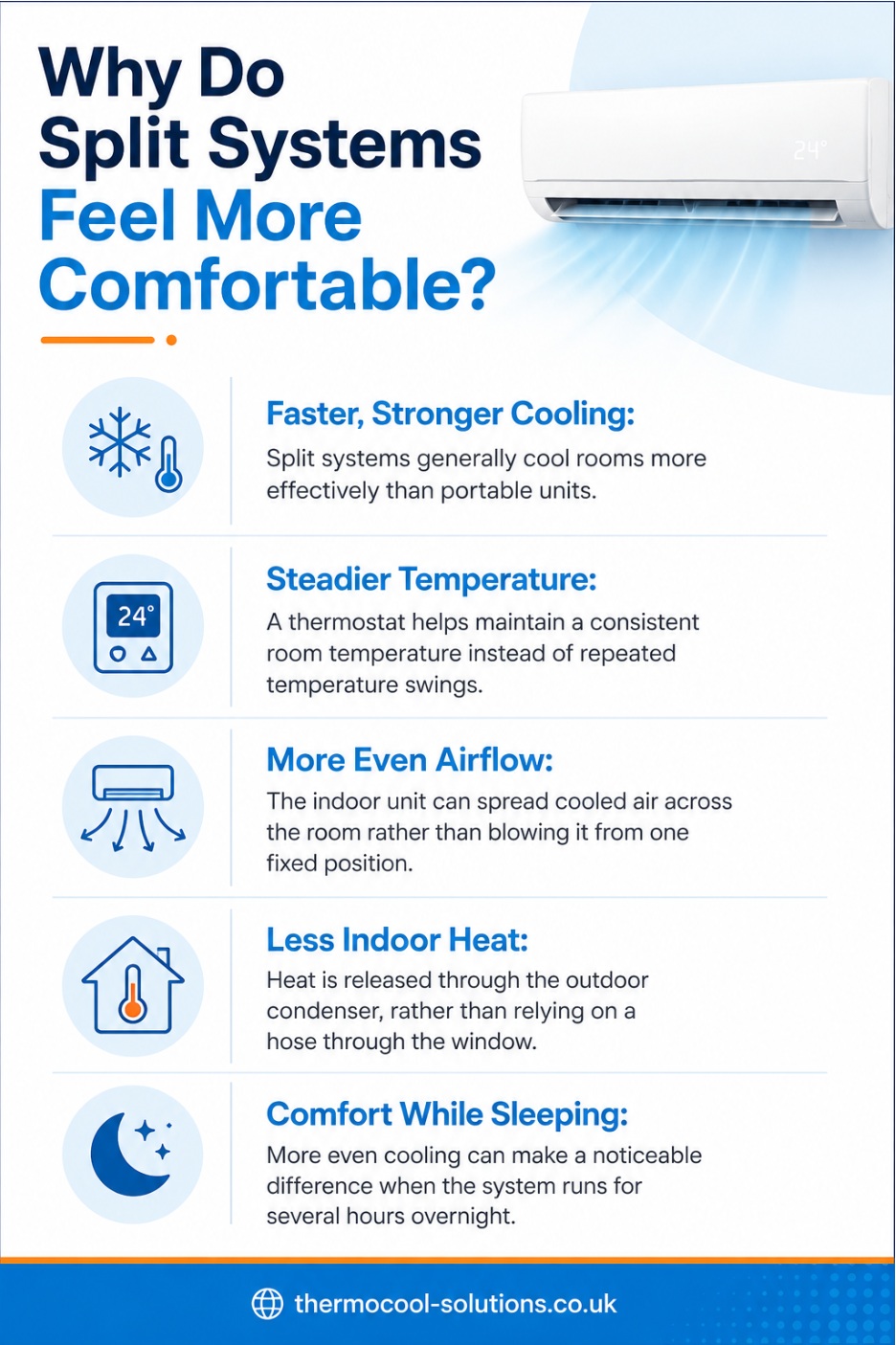
Split systems generally provide stronger and more consistent cooling.
A University College London study tested a single split system and a portable air conditioner in real UK home conditions. The tested split system recorded an energy efficiency ratio of 5 to 10, while the portable unit recorded less than 1. The researchers noted that these results came from limited testing, so they should not be treated as typical for every model.
Portable units can still work well in a small room. However, they may struggle more in larger spaces, especially when warm air is not being removed efficiently.
Heating Performance
A further advantage of many split systems is that they can provide heating as well as cooling.
This is because many modern split systems use heat pump technology. A portable air conditioner, on the other hand, is commonly bought for cooling and may not provide the same heating capability.
That can make a split system more useful throughout the year.
Temperature Control
Split systems usually offer more precise temperature control.
The UK in use study found that occupants generally switched their air conditioning on at around 24°C to 25°C. Typical use was around five hours during the day and seven hours at night in bedrooms.
A good thermostat can help the system maintain a comfortable temperature instead of simply running flat out.
Airflow and Comfort
Portable units tend to direct cooled air from one position in the room.
Split systems can distribute air more evenly, depending on the indoor unit and its position. This can make a noticeable difference when you are sitting or sleeping in the room for several hours.
Nobody wants an ice blast aimed at their face while the other side of the room feels like July.
How Much Does Portable vs Split Air Conditioning Cost?
A portable air conditioner normally costs less to buy and does not usually need separate professional installation. That makes it attractive when you need a quick and temporary cooling solution.
A split system has a higher upfront cost due to the need for:
- An outdoor unit which adds to the overall purchase and installation cost
- Pipework to connect the indoor and outdoor units
- Professional installation to ensure the system is fitted correctly
- Qualified refrigerant work to safely handle and charge the refrigerant
For stationary air conditioning systems containing F gas, the person carrying out the work must have the correct individual qualification, as noted in GOV.UK’s guidance on qualifications required to work with F gas. This applies to installing, servicing, maintaining, checking for leaks and recovering refrigerants. GOV.UK also states that working with F gas without the correct qualification is against the law.
There can also be ongoing servicing and maintenance costs with a split system. When choosing an installer or engineer, check that the company has the required certification for F gas work.
If you are considering professional domestic air conditioning, the installation quality matters just as much as the equipment you choose.
The cheapest system to buy is not necessarily the cheapest system to own.
The 2026 Ofgem price cap sets electricity at 26.11p per kWh for a typical direct debit household. Portable units commonly draw around 0.8kW to 1.6kW, depending on their size and specification.
Actual running costs will vary with the unit, room, temperature setting, usage and electricity tariff, so fixed figures can give a misleading impression.
Portable Air Conditioner vs Split System (Which Is Best for Your Home)
There is no single winner for every UK home. The better choice depends on your property, how long you plan to stay there and how often you need cooling.\
Best for Homeowners
If you own your home and expect to stay for several years, a split system is usually the more sensible long term investment.
You can make the changes needed for permanent installation and benefit from better cooling and efficiency over repeated summers.
It also avoids having to find somewhere to store a bulky portable unit when it is not being used.
Best for Renters
Portable air conditioners can be a better fit for renters.
You can install one without making permanent changes to the property, and you can take it with you when you move. There is also no outdoor condenser that needs to be positioned on the property.
That flexibility is difficult to beat when you do not own the building.
Best for Small Homes and Flats
A portable unit can work well when you only need to cool a small room.
It can also avoid some of the planning and installation questions associated with an external condenser. Flats can face additional restrictions around outdoor units, so this is worth checking before choosing a split system.
Best for Larger Properties
Larger homes generally benefit more from a split system.
Its stronger and more consistent cooling can make it a better option for bigger rooms or regular cooling across several areas.
If you are considering a permanently installed system, wall mounted air conditioning can be a practical option for domestic spaces where the indoor unit can be positioned effectively.
What to Consider When Choosing Between Portable and Split AC
The location of the outdoor condenser can be an important deciding factor if you are considering a split system.
You need to think about where the unit can be placed in relation to boundaries, windows, roofs and neighbouring properties. Permitted Development rules also set conditions around outdoor units, including size and location.
For homes in England, check the current planning permission rules for split system outdoor units before installation. planning permission rules for split system outdoor units
The rules include conditions on the volume of the outdoor unit and where it can be installed. Some property types also have tighter restrictions, while Listed Buildings and Scheduled Monuments can fall outside normal Permitted Development rights.
There is another simple question to ask.
Will you use the same rooms every summer?
If the answer is yes, permanent installation starts to make more sense. For regular, long term cooling, wall mounted air conditioning can provide a practical permanent setup. If you only need cooling for occasional hot spells or expect to move soon, a portable unit may be the more practical choice.
FAQs
Is a split system better than a portable air conditioner?
Usually, yes. Split systems generally provide stronger cooling, better efficiency, quieter operation and more precise temperature control.
Are portable air conditioners worth buying in the UK?
Yes, particularly for renters, small rooms or occasional use where permanent installation is not practical.
Which air conditioner is cheaper to run?
Split systems are generally more efficient. A UK in use study found a major efficiency difference between tested split and portable systems.
Which air conditioner is quieter?
Split systems are generally quieter indoors because the main heat rejecting components sit outside.
Do I need planning permission for a split system?
Not always. Certain installations can fall under Permitted Development rules if all conditions are met. Check the current rules before installation.
How long do portable and split system air conditioners last?
Lifespan varies with the equipment, installation, usage and maintenance. Good maintenance can help either type remain reliable for longer.
Conclusion
At Thermocool Solutions, we help you compare portable and split systems based on your home, usage and long term needs. We provide professional F Gas certified installation, planning guidance, servicing and maintenance, plus clear advice before you commit.
If a split system looks right for your home, you can get your free quote today.