
0% VAT On All Domestic Air Conditioning and Heat Source Heat Pumps. Contact Us Now >>

How to Read Air Conditioning Model Numbers in the UK

reading the AC codes
Picture of Dave Berry
Dave Berry

Director of Thermocool Solutions

Table of Contents
Need Air Conditioning?

Speak to an Engineer

Table of Contents

Quick Answer: Air conditioning model numbers in the UK are manufacturer-specific codes. They typically reveal capacity, unit type, series, and refrigerant generation through brand-coded formats.

Air conditioning model numbers in the UK aren’t one-size-fits-all. Each brand uses its own code system, and the letters and numbers can reveal system size, unit type, product range, and features.

Spotting the manufacturer, capacity code, and key letters gives you a good idea of what you’re looking at. Still, check the product sheet, as similar codes can mean completely different things.

Key Takeaways

  1. Model numbers are brand-specific codes that reveal capacity, unit type, and series but lack universal UK standardisation.
  2. The capacity code often appears as a number block representing BTU or kW class within that brand’s range.
  3. Indoor and outdoor units must match correctly, so checking both model codes prevents expensive installation mistakes.

What is an Air Conditioning Model Number?

An air conditioning model number is basically the unit’s ID tag. It gives you clues about what type of system it is, how powerful it is, and which product range it belongs to.

Sometimes, even the features are packed into it. Installers use these codes to make sure they’re matching the right indoor and outdoor units.

Model numbers usually begin with a manufacturer code, followed by numbers linked to capacity or size. Extra letters can point to a product series, refrigerant generation, or specific features. There’s no UK-wide standard though, so every brand uses its own format. That’s why the product sheet is still the safest way to confirm exact specs.

Where to Find the Model Number

Trying to find your air conditioning model number? You usually won’t need to hunt very far. It’s printed on a sticker or rating plate attached to the unit itself.

For indoor units, check the side panel or lift the front cover and look around the edges. On outdoor units, it’s often placed on the side of the casing or close to the electrical connection area. 

If you’re checking compatibility or ordering replacement parts, have a look at both the indoor and outdoor units, as the information can differ between them.

How to Read Air Conditioning Model Numbers

Model codes follow a structure that makes sense once you understand the pattern.
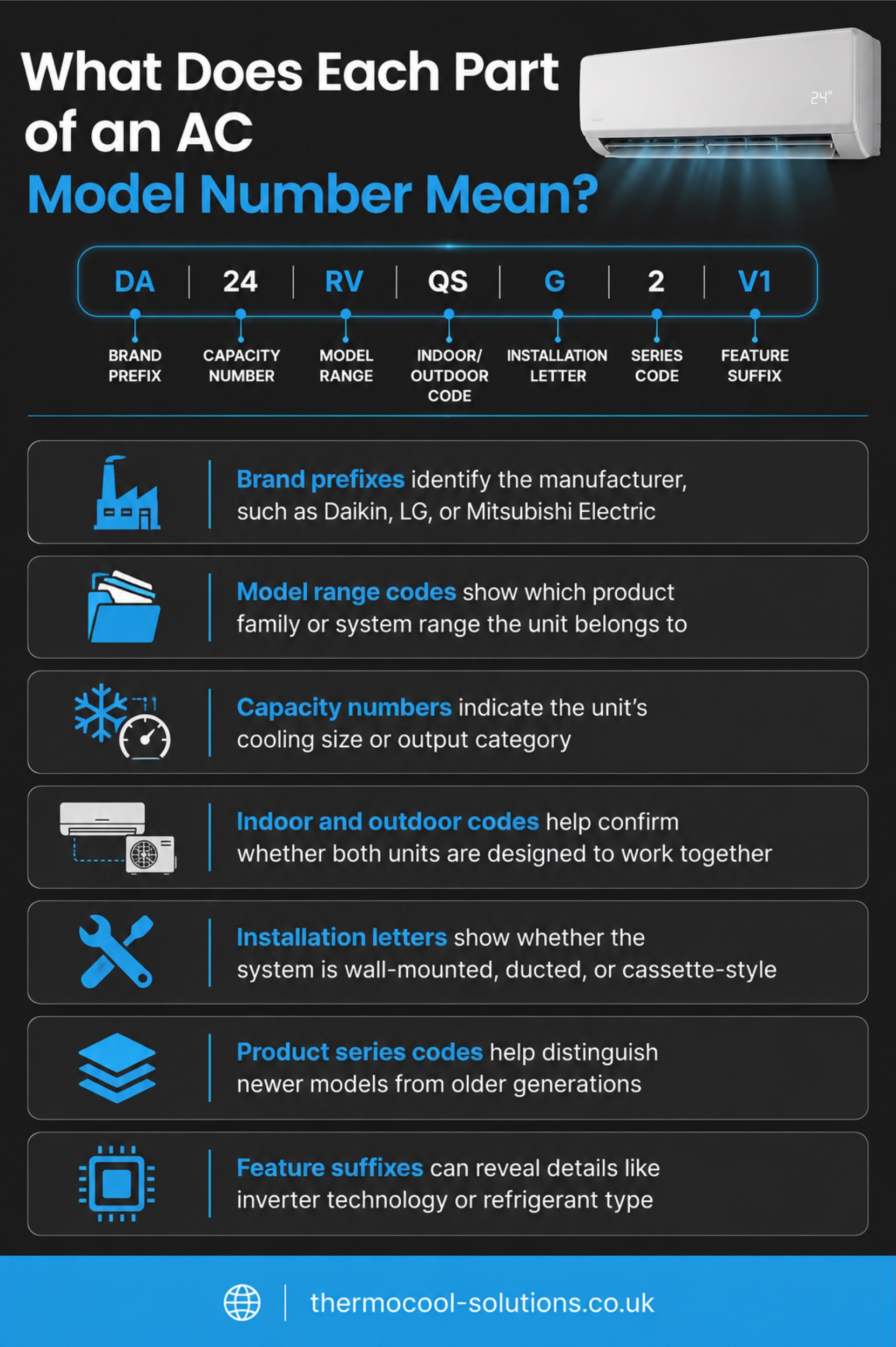
what does each part of an AC model number mean

The code breaks into sections that each reveal different information.

Brand Prefix

The opening letters usually identify the manufacturer. For example, Daikin often uses codes like FTXS or RXS, while Mitsubishi Electric uses prefixes such as MSZ or MUZ. These letters give you a quick clue about who made the unit before you look at anything else.

Model Range

The remaining letters or code combinations can point to a specific product family or range. LG, for example, uses patterns like ARNU and H series across different systems.

Product ranges help installers identify compatible components, as some families share parts while others use completely different setups.

Capacity Code

The number block usually signals capacity class within that brand’s range. A code showing “09” often means 9,000 BTU or roughly 2.5kW. A “12” typically signals 12,000 BTU or around 3.5kW.

LG’s ARNU12GSJC4 is presented as “12kBTU” with 3.60kW cooling capacity listed. Mitsubishi Electric’s P25VLRM-E lists 2.8/3.2kW cooling and heating. The number relates to capacity class but exact output needs checking against the datasheet.

Indoor and Outdoor Unit Codes

Some model numbers include codes that tell you whether you’re looking at an indoor or outdoor unit. Brands such as Daikin use different prefixes for each. This matters with split systems because both units need to match and work together properly.

Installation Type

Certain letters in the model number can also show how the system is designed to be installed. Wall-mounted units, floor-standing models, ceiling cassettes and ducted systems often use different code patterns. These designations help identify the type of setup within the same product range.

Product Series

Letters after the capacity code can show where a unit sits within a manufacturer’s range. They may point to a specific product generation or indicate whether the system belongs to an older or newer series. Some brands update these codes every year, while others keep them for much longer.

Feature Codes

Extra letters can sometimes reveal details, such as inverter technology, energy efficiency level, control options, or refrigerant type. Small code changes may also signal newer refrigerants. For example, later model generations can reflect the shift from R-410A to R-32 refrigerants.

How to Identify Cooling Capacity

Capacity determines whether the unit suits your space. The wrong choice means poor cooling or wasted energy. The model code gives strong clues but needs verification.

The following capacity guide shows typical code-to-output relationships:

Common Code Approx BTU Approx kW Typical Room Size
09 9,000 2.5kW Small room (up to 20m²)
12 12,000 3.5kW Medium room (20–35m²)
18 18,000 5kW Large room (35–50m²)
24 24,000 7kW Open area (50–70m²)

Some brands use BTU, while others use kW ratings. Capacity codes give a rough size class rather than exact performance, so always check the product sheet for confirmed output figures.

How Climate Change Is Affecting AC Choices

UK summers are getting hotter and more uncomfortable without cooling. The climate has been warming steadily over recent decades, which makes choosing the right capacity more critical now than it was ten or twenty years ago.

Official climate data shows the UK has warmed at roughly 0.25°C per decade since the 1980s, with the last three years among the UK’s five warmest on record.

That warming trend means undersized units struggle more often while oversized units waste energy cycling on and off. AC ownership in UK homes has jumped recently. More households are buying cooling systems as summers become less tolerable, which means capacity decisions affect more people every year.

Recent household surveys found AC ownership ranging from 8 to 19% in Great Britain, with 81% of AC-owning households buying their unit within the previous two years.

The same research shows England’s cooling-degree-day to heating-degree-day ratio is projected to rise from 1/85 to 1/27, while London’s ratio could reach 1/13. That shift from heating-dominated to more balanced heating-cooling needs means correctly sized AC units matter far more than they did when UK homes rarely needed cooling.

Top AC Brands in the UK and Their Model Formats

Each major brand uses a different coding approach. 

what does each part of an AC model number mean

The patterns below help you decode unfamiliar units faster.

Daikin

Daikin codes often show three-letter prefixes. FTXS signals wall-mounted indoor units. RXS indicates outdoor condensers.

The number following these letters represents capacity class. Daikin installation manuals explicitly tell installers to confirm model name and serial number before fitting. That prevents mix-ups between indoor and outdoor units during installation.

Mitsubishi Electric

Mitsubishi Electric uses MSZ for indoor units and MUZ for outdoor units. The letters following the capacity code signal series and feature level. Their P25VLRM-E model lists 2.8/3.2kW cooling and heating output.

The brand updates series letters as energy ratings improve. Older codes may use different suffixes even when capacity remains similar.

Fujitsu

Fujitsu uses compact codes with capacity indicators following similar BTU-based patterns to other Japanese manufacturers. Series letters change between product generations.

The brand emphasizes matching indoor and outdoor codes correctly (because split systems fail if components from different series get mixed).

Panasonic

Panasonic follows a similar compact coding approach. Their capacity codes align with BTU classes. Series letters update as new models launch.

Always verify compatibility between indoor and outdoor units before ordering replacement components.

LG

LG uses codes like ARNU12GSJC4 for 12kBTU units or H12S1D for 3.5kW models. Number blocks represent capacity tiers within their range. Korean manufacturers sometimes show features in the suffix letters (which can include inverter type or energy class).

Samsung

Samsung follows similar logic with number blocks representing capacity tiers. Their codes also embed feature information in suffix letters. Both LG and Samsung list capacity in multiple formats on UK product pages (which helps buyers cross-reference BTU, kW, and room-size guidance).

We handle air conditioning services for homeowners and businesses who need help selecting matched systems or replacing failed components. Professional sizing prevents the efficiency losses that come from incorrectly matched units.

Difference Between Model Number and Serial Number

The model number identifies the product type. The serial number identifies the individual unit. They serve different purposes and should not be confused.

You can tell model and serial numbers apart because:

  • Model numbers describe the product version or family
  • Serial numbers track the exact unit produced
  • Service and warranty support often depends on both details

Parts orders typically need the model number only. The model number helps you find compatible components. The serial number helps manufacturers track production batches and recall histories (which matters for safety recalls or quality investigations).

Mistakes to Avoid When Decoding Air Conditioner Codes

It’s easy to misread an air conditioning model number, especially when different brands use different coding systems. A small mistake can lead to ordering the wrong parts, choosing an unsuitable unit, or creating compatibility issues.

Some of the most common decoding mistakes are:

Common Mistake What People Assume What To Do Instead
Confusing model and serial numbers They mean the same thing Check the data plate carefully
Assuming all brands use the same code system Numbers and letters follow one universal format Check the manufacturer’s documentation
Misreading capacity values Capacity codes show exact output Use the product fiche to confirm actual heating and cooling performance
Incorrect indoor and outdoor matching Similar numbers automatically work together Confirm both units are approved as a matched pair

Model numbers give useful clues, but they do not tell the full story on their own. Similar codes can hide important differences between product generations, output levels, and compatibility requirements.

Getting these details right also makes servicing much easier over time.

Our service packages include annual maintenance where correct model logging helps us track system history and anticipate component wear. Accurate records prevent delays when replacement parts need ordering urgently.

UK Refrigerant Compliance

UK refrigerant rules are pushing manufacturers towards cooling gases with a lower environmental impact. Air conditioning model numbers can sometimes give clues about which refrigerant a system uses, and that matters because older refrigerants with higher climate impact are gradually being phased out.

The UK’s fluorinated gas (F-gas) regulations require a 79% reduction in hydrofluorocarbon (HFC) use between 2015 and 2030. Since 1 January 2025, single-split air conditioning systems containing under 3kg of refrigerant cannot use F-gases with a Global Warming Potential (GWP) of 750 or above.

For example, R-410A is an older air conditioning refrigerant (the cooling gas that moves heat through the system). It has a Global Warming Potential (GWP) rating of 2,088, meaning it has a relatively high environmental impact. R-32 is a newer refrigerant used in many modern systems and has a lower GWP rating of 675, making it a more environmentally friendly option.

Some manufacturers reflect this shift through small changes in model codes or series letters, which can help buyers spot newer, regulation-compliant systems before installation.

Conclusion

Model numbers reveal useful clues about capacity, unit type, and system compatibility. However, manufacturer documentation remains the final authority because coding systems vary between brands. Always verify specifications from the official product sheet before purchasing or replacing components.

Need help choosing the right system? Contact us for a quote and get expert advice on correctly matched components for your property.

FAQs

What do AC model numbers mean?

Model numbers identify the product family, capacity class, unit type, and feature level. They help match indoor and outdoor units correctly during installation or replacement.

Where is the model number on an AC unit?

The model number appears on a label or data plate. Check the indoor unit’s side panel or behind the front cover. Outdoor units show it near the electrical connection box.

Can I tell how old my AC is?

The serial number often includes a date code. Contact the manufacturer with the serial to confirm production year. Model numbers alone do not reveal age.

What does BTU mean on an air conditioner?

BTU stands for British Thermal Units. It measures cooling capacity. Higher BTU numbers mean more cooling power.

12,000 BTU roughly equals 3.5kW.

Is a model number the same as a serial number?

No. Model numbers identify the product type. Serial numbers identify the individual unit. Both appear on the data plate but serve different purposes.