

Quick Answer: As of October 2026, air conditioning costs roughly 26p–71p per hour at full load. Inverter units usually draw less after startup once rooms cool down, because compressors reduce power draw.
Air conditioning running costs UK households face depend mainly on unit power draw and the electricity tariff. Once you know the unit’s electrical input, its hourly cost is simple to calculate. Actual consumption changes as rooms cool and outdoor temperatures shift. Inverter systems often reduce power draw after startup. Tariffs and usage determine the final monthly bill for your home.
Key Takeaways
- Air conditioning costs around 26p–71p per hour at full load, depending on the unit’s electrical input.
- Actual running costs are often lower because inverter systems reduce power as rooms cool.
- Electricity tariffs, room insulation, outdoor temperatures and thermostat settings affect how much energy your system uses.
- Timers, closed windows, shading, clean filters and regular servicing can help reduce running costs.
How Much Does Air Conditioning Cost to Run Per Hour?
Hourly running costs depend on the unit’s electrical input in kilowatts (kW) and your electricity rate in pence per kilowatt-hour (kWh). Use this formula:
Hourly cost = electrical input (kW) × electricity rate (p/kWh)
According to Ofgem’s current electricity price cap, the average electricity rate is 26.32p/kWh for Direct Debit customers on standard variable tariffs from 1 October to 31 December 2026. This rate covers England, Scotland and Wales. Your own tariff and region may differ.
The table below shows approximate hourly running costs at full load (based on an electricity rate of 26.32p/kWh as of October 2026):
| Electrical Input | Example Unit | Approx. Cost Per Hour at Full Load |
|---|---|---|
| 0.5kW | Lower power draw | 13.16p |
| 1.0kW | Small portable unit | 26.32p |
| 1.5kW | Higher electrical input | 39.48p |
| 2.0kW | Mid-size wall-mounted split | 52.64p |
| 2.7kW | Larger built-in split system | 71.06p |
Note: These estimates use electrical input, not the cooling capacity advertised in kW. Cooling output and electricity consumption measure different things. Actual costs can be lower because inverter systems adjust their power draw as the room reaches the set temperature. The figures also exclude standing charges, which apply separately.
How Much Does Air Conditioning Cost to Run Per Day and Month?
Daily and monthly costs depend on operating hours and the power the unit draws during use.
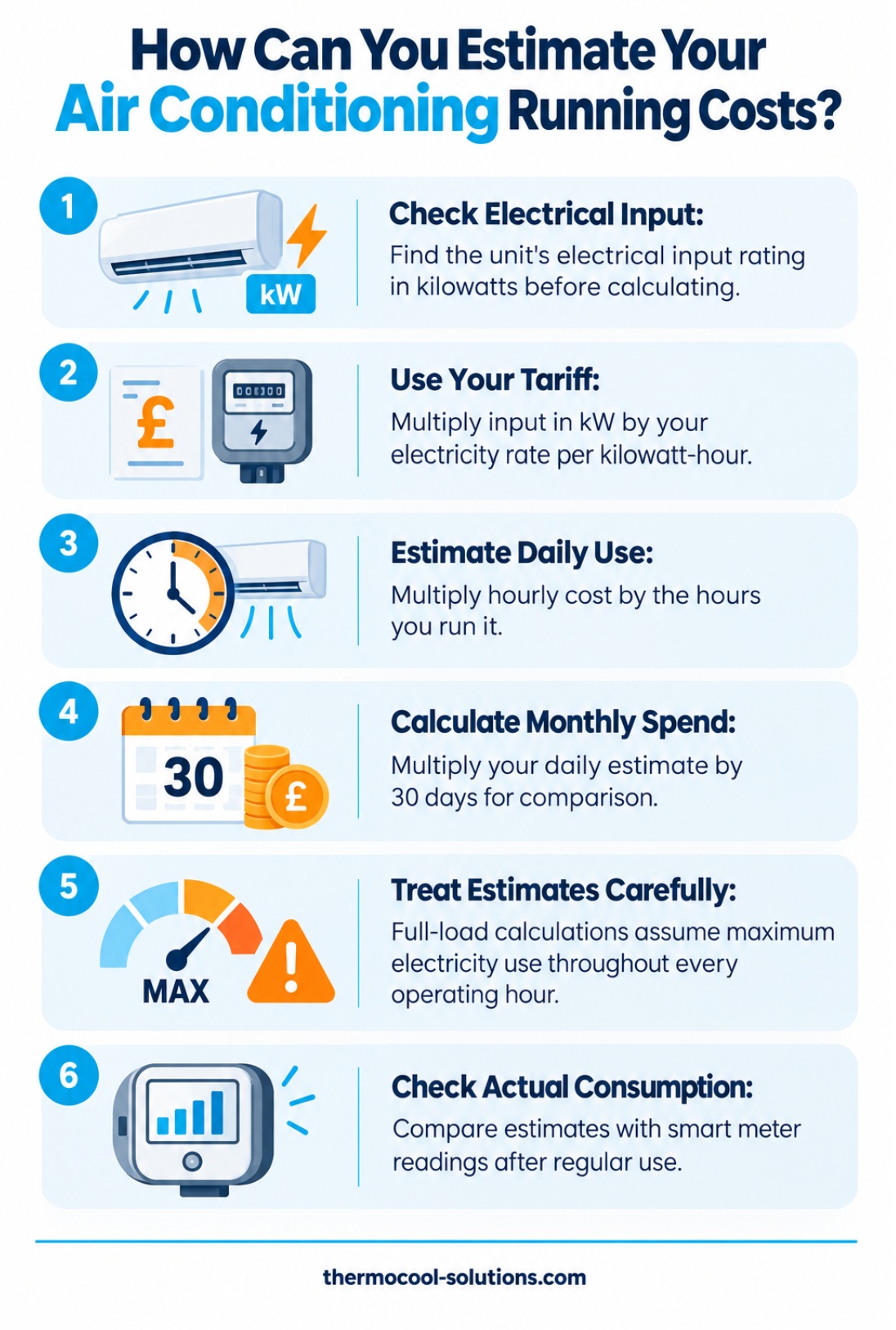
The figures below assume full load throughout, so they provide an estimate rather than a prediction of a typical bill:
Cost of Running Air Conditioning for 4, 8 and 12 Hours
The table shows illustrative costs at full load using the October 2026 electricity rate.
| Unit Type | 4 Hours | 8 Hours | 12 Hours |
|---|---|---|---|
| Small portable unit, 1.0kW | £1.05 | £2.11 | £3.16 |
| Mid-size split system, 2.0kW | £2.11 | £4.21 | £6.32 |
| Larger split system, 2.7kW | £2.84 | £5.69 | £8.53 |
For example, running a 2kW unit at full load for four hours costs around £2.11. The actual amount depends on how hard the compressor works during those hours.
Cost to Run Air Conditioning Overnight
Overnight running costs are often lower than the full-load estimates above. Once a room reaches its target temperature, an inverter unit can reduce its power draw to maintain comfortable conditions.
The cost still depends on room insulation, outdoor temperature and the temperature setting. Timers and sleep modes can also limit unnecessary operation.
Cost to Air Conditioning Run for a Month
Monthly running costs depend on how long you use the air conditioner each day. At an electricity rate of 26.32p/kWh, a 2kW unit running at full load for four hours daily would cost around £63 per month. Running it for eight hours daily would cost around £126.
These are illustrative estimates based on 30 days of use. Actual costs are often lower because inverter systems reduce their power draw as rooms cool. Your electricity tariff, room conditions and cooling settings also affect monthly spending.
What Affects Air Conditioning Running Costs?
Two households using air conditioning for similar periods can receive different bills. The unit’s efficiency, the room’s cooling demand and the electricity tariff all influence consumption.
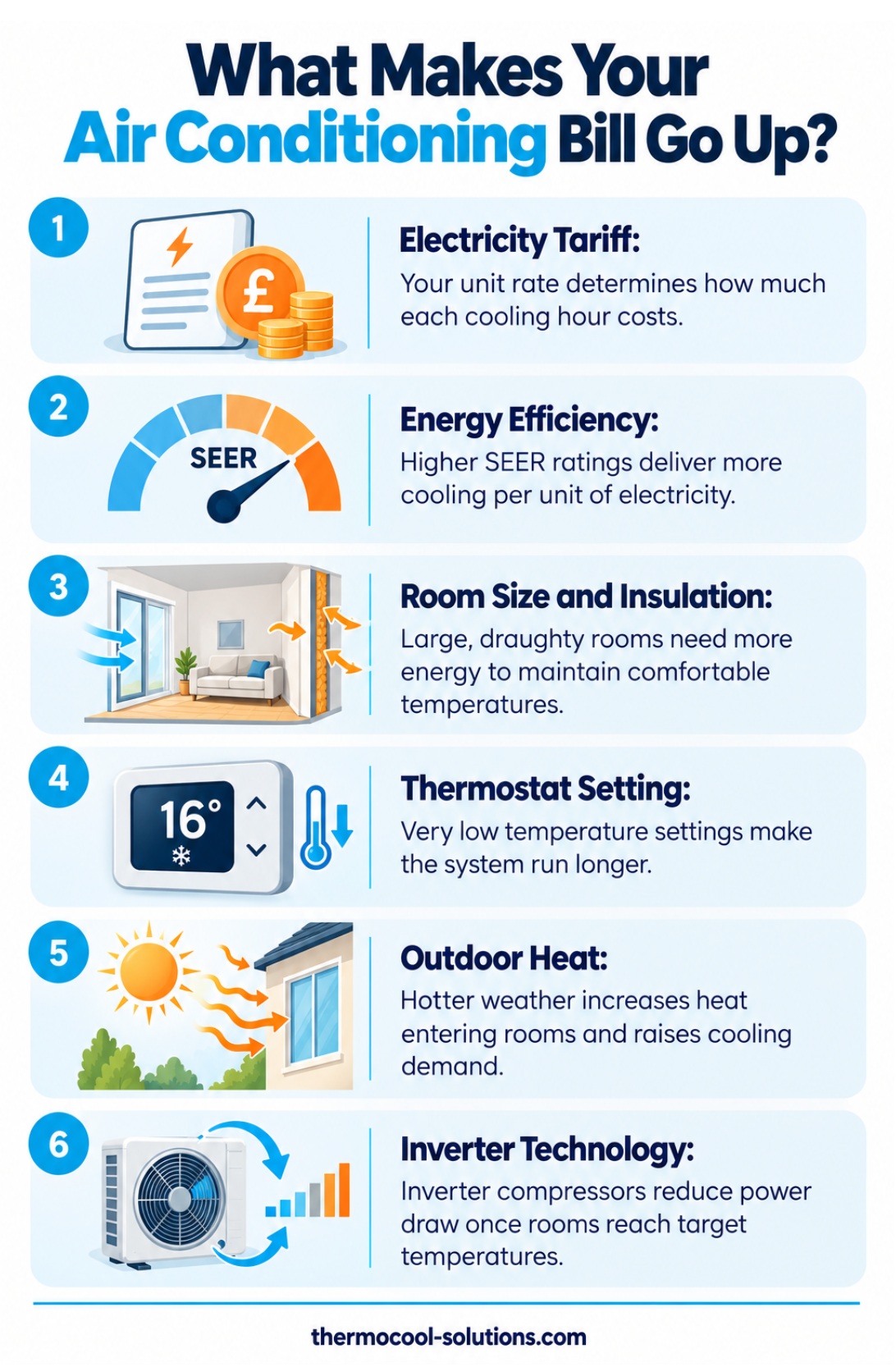
These are the main factors to consider:
Electricity Prices and Energy Tariffs
Your electricity unit rate directly affects each hour of cooling. Ofgem reviews the price cap quarterly, while fixed tariffs and time-of-use deals can charge different rates. Use your own electricity rate for a more accurate calculation rather than relying on the national average.
Air Conditioning Energy Efficiency Ratings
The energy label helps compare how efficiently a unit cools a room. SEER measures seasonal cooling efficiency, while SCOP measures seasonal heating efficiency for systems that also provide heating.
A higher SEER generally means the system uses less electricity to deliver the same cooling over the season. Energy labelling rules cover relevant air-to-air units up to 12kW of cooling output.
Room Size and Insulation
A large room generally needs more cooling than a small one. Poor insulation, draughts and direct sunlight can also increase the workload. Choosing a unit suited to the room helps avoid excessive running time or inefficient cycling.
Temperature Settings and Outdoor Weather
Hotter weather increases the amount of heat entering your home. Setting the air conditioner to a very low temperature also makes it work harder for longer.
The Met Office’s report on UK record temperatures and warming trends confirms that 2022 reached a UK record of 40.3°C and was the warmest year on record at that time. High outdoor temperatures can therefore increase demand for cooling.
Inverter Technology and Energy Consumption
An inverter compressor adjusts its speed to match the room’s cooling demand. Once the room cools, the system can reduce its power draw instead of repeatedly running at full capacity. This is why an inverter unit’s average hourly cost can be lower than its rated full-load estimate.
Is Air Conditioning Expensive to Run in the UK?
Air conditioning isn’t automatically expensive to run. Cooling one occupied room for a few hours can be manageable, while long operating periods, high power draw and inefficient equipment increase electricity use. Your actual bill also depends on the unit’s efficiency and the tariff you pay.
Air conditioning remains relatively uncommon in English homes. Analysis of the 2023–24 English Housing Survey found that 4.3% of homes, around 1.06 million households, used it. The research on UK household air conditioning use examines which households use these systems and the factors influencing adoption.
Cooling also adds to electricity demand beyond homes. A 2021 government study on UK cooling estimated that cooling buildings could account for almost 10% of UK electricity consumption (with the research focused largely on offices and retail). This provides a wider energy context rather than a measure of domestic running costs.
Is Fixed Air Conditioning Cheaper to Run Than Portable Units?
Fixed split systems often use less electricity than portable units for equivalent cooling, although the result depends on the model, room and usage. A split system transfers heat outdoors through a dedicated outdoor unit. A portable air conditioner usually expels warm air through a hose, which can draw replacement warm air into the room.
Fixed systems cost more to install, but their running efficiency may justify that outlay if they are used regularly. Our domestic air conditioning service explains the options available for home installations.
Installer competence matters a lot. MCS’s 2026 update sets a Level 3 RACHP competence requirement for the Technical Supervisor assigned to air-to-air heat pump installations. Read the installer certification guidance for air-to-air systems when checking installer credentials.
How Can You Reduce Air Conditioning Running Costs?
Air conditioning costs less to run when your room stays cool without the unit working harder than necessary. Reducing heat from sunlight, limiting warm air entering the room, and using the controls properly can help lower electricity consumption.
To reduce unnecessary cooling and keep the system working efficiently, try to:
- Choose a moderate temperature to avoid excessive cooling.
- Use timers and app controls to cool rooms only when needed.
- Keep windows and doors closed while the air conditioning runs.
- Use blinds or external shading to block direct sunlight.
- Improve insulation to reduce heat entering the home.
- Clean filters regularly to maintain airflow.
- Choose the right unit size to avoid continuous running or inefficient cycling.
Regular servicing also helps identify maintenance issues that affect performance. We offer service packages to help keep air conditioning systems properly maintained.
FAQs
How Much Does It Cost to Run a 3.5kW Air Conditioner Per Hour?
If 3.5kW is its electrical input, it would cost about 92p per hour at 26.32p/kWh. Check the unit’s rated input.
Is It Expensive to Run Air Conditioning in a Bedroom?
It can be manageable for occasional use. Costs depend on the unit’s electrical input, room conditions and operating hours.
Does Air Conditioning Use Electricity When Switched Off?
Some units draw a small standby amount while plugged in. Check the manufacturer’s specifications for your model.
What Is the Cheapest Temperature to Run Air Conditioning At?
A moderate setting that keeps the room comfortable generally reduces workload compared with an unnecessarily low setting.
How Can I Check My Air Conditioning Electricity Consumption?
Check the product’s electrical input rating or use a suitable energy monitor. Smart meter data can also help track household electricity use.
Conclusion
Air conditioning running costs depend on electrical input, electricity rates, efficiency, and how the system is used. Full-load calculations provide a useful ceiling, while inverter units often draw less during normal operation. Room conditions and maintenance also affect consumption.
For advice on a suitable system and its expected running costs, get a free quote today for a tailored estimate.