


Quick Answer
Air conditioners cool indoor spaces by removing heat and moisture from indoor air and transferring that heat outdoors using a closed refrigerant cycle. AC moves heat rather than making cold.
Air conditioning works through continuous heat transfer rather than cold generation. The refrigeration cycle circulates refrigerant through the compressor, condenser, expansion device, and evaporator components, moving heat from indoors to outdoors while removing moisture. Let us explain each step of the cooling process and why understanding how AC works helps you choose and maintain systems properly.
Key Takeaways
- AC doesn’t create cold air, it basically moves heat from inside your home to outside.
- Every AC system uses the same four-step refrigeration cycle: evaporate, compress, condense, and expand.
- Proper sizing, regular maintenance, and smart controls are the biggest factors in efficiency and running costs.
How Cooling Really Works
The top misconception about air conditioning is that it makes cold air. Air conditioners actually remove heat from indoor air and reject it outside, which makes the remaining indoor air feel cooler. Heat must be moved somewhere else because thermodynamics prevents simply destroying it.
A refrigerator works the same way, moving heat from inside the box to the kitchen. A sponge wringing water out provides another useful analogy, where the AC wrings heat energy out of indoor air and squeezes it outdoors.
Heat pumps reverse this process for heating.
Humidity removal happens simultaneously because cold evaporator coils cause water vapour to condense out of warm indoor air, and drier air feels cooler even at the same temperature.
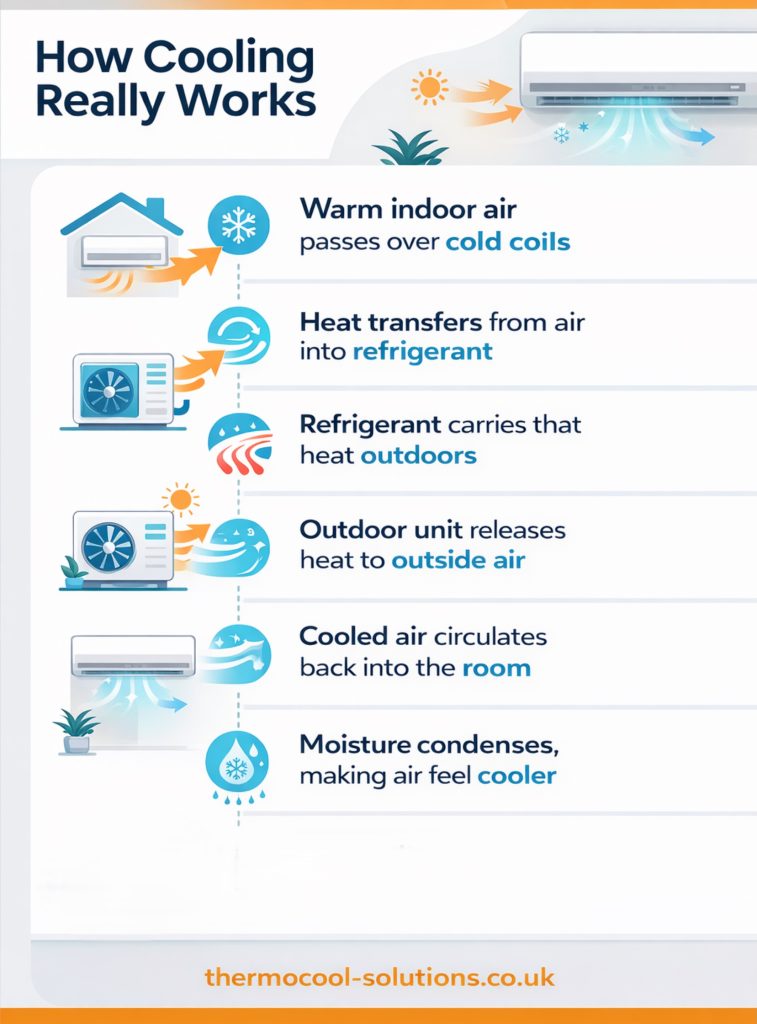
The Five-Step Air Conditioning Cycle
Air conditioners cool your home using a continuous refrigeration cycle that transfers heat from indoors to outdoors. Breaking this into five simple steps makes the process easy to follow. The cycle starts inside your home, where warm air first meets the cold evaporator coil.
Step 1: Heat Absorption
Inside your home, warm air passes over a very cold coil (the evaporator).
The cold refrigerant inside that coil absorbs heat from the air. As heat is removed, the air becomes cooler and is blown back into your rooms.
The refrigerant warms up during this step, but it stays cool enough to keep pulling heat out of the air.
Step 2: Evaporation
As the refrigerant absorbs heat, it changes from a liquid into a gas. This change of state allows it to remove a large amount of heat quickly and efficiently.
The low pressure inside the system keeps the refrigerant cold enough to cool your home properly.
Step 3: Compression
The compressor pulls in the warm refrigerant gas and squeezes it tightly.
When a gas is compressed, its temperature rises. This makes the refrigerant much hotter than the outdoor air, which is important for the next step.
Step 4: Heat Release
The hot refrigerant moves to the outdoor unit. A fan blows outdoor air across the coil, allowing the heat to leave the refrigerant. As it loses heat, the refrigerant turns back into a liquid.
This is the point where the heat from inside your home is actually released outside.
Step 5: Expansion and Cycle Reset
Before returning indoors, the refrigerant passes through an expansion device that quickly lowers its pressure. When pressure drops, the refrigerant becomes cold again.
It then returns to the indoor coil, ready to absorb more heat, and the cycle repeats.
Key Components of an AC System
An air conditioning system works because different parts handle airflow, heat transfer, and temperature control. These components are split between the indoor and outdoor units, and each one has a specific role in keeping your home comfortable.